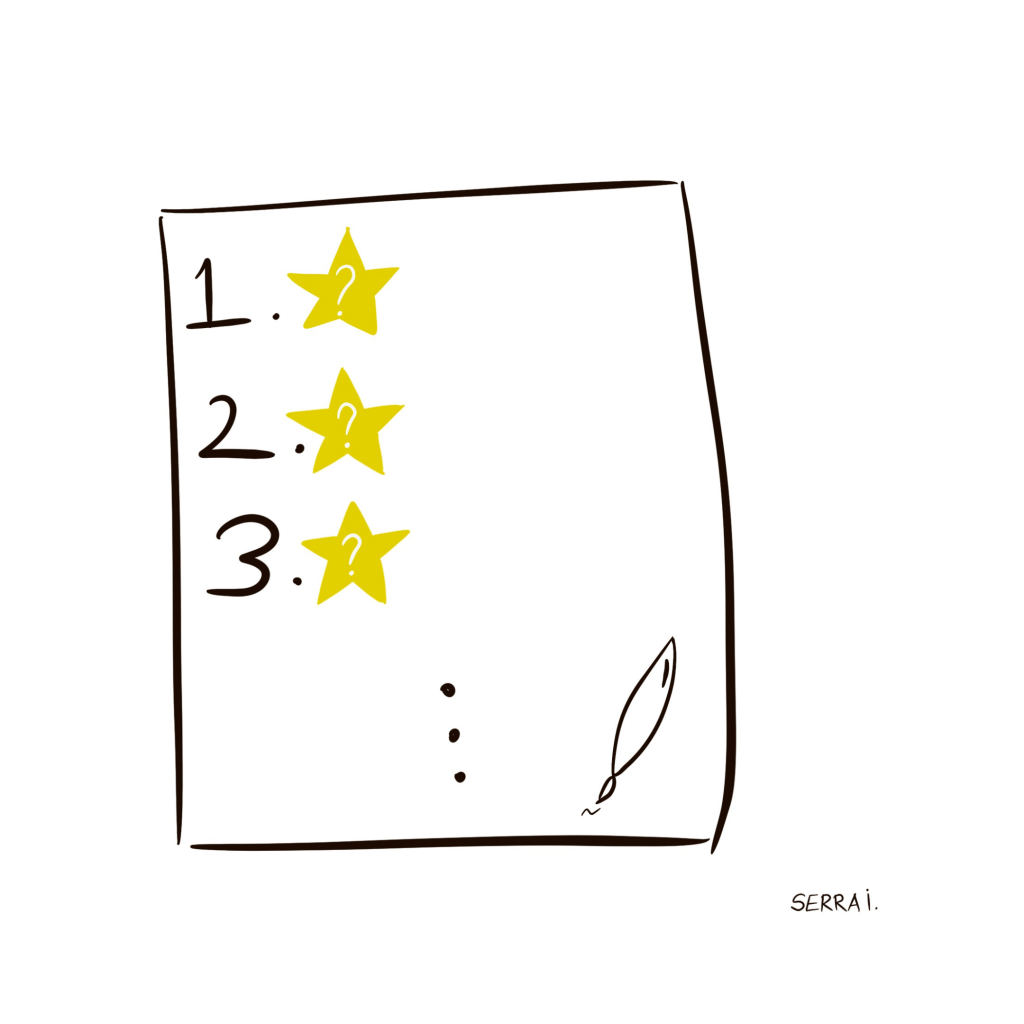
This is the first blog post of the year! 🌱 That’s why I chose a topic that may inspire you throughout the year and when you think about new beginnings. While I was preparing, I wrote and drew with excitement . 🤩 Focusing more on the topic, the beginning of the year is often paired with new goals. 🎄✨ What do you value when you are setting goals? In this article, I will be sharing questions that I think may inspire you. 🖊 If you find / have more questions while reading, you can add them to your list. After all, this is your list and no one knows you better than you. ☺️
1-Does this decision really reflect me?
Does this decision support me?
What is the value of this decision?
Can I see myself in that film/photo/picture?
2- When I think about the answers to the questions in the first step, what are my goals in particular? What will be their contributions ? What can I do to walk towards to the point I want? What will keep me on the road with determination?
3- By starting with especially which one will make it easier for you to reach your other goals?
Before I start the article, I want to ask you a question; What do you think is creativity? Which traits make a person creative?
While you are thinking about the answer, I am writing my answers here: In my opinion, creativity is being able to see and use our creative potential in more than one way.
To understand the subject from other angles, I did some more research and found another resource. Resource had a point of view that connected with other sources I had previously read and watched. Particularly, the creative process and the definition of being in the flow as the secret of happiness and the title of “Defining the Skill of the Future” were the parts that made me curious. (1)
Other than this definition, what made this article valuable?
Creativity make your ideas, imagination and dreams come true. When you are creative, you can see hidden patterns, make connections between things that are not normally relevant, and come up with new ideas. Creativity depends on creative thinking, which is part of the hard work but is connected more to creative problem solving. (2)
Mihaly Csikszentmihalyi says describes someone involved in the creative process as“ He can’t feel even that he’s hungry or tired, his body disappears, his identity disappears from his consciousness because he doesn’t have enough attention, like none of us do, to really do well something that requires a lot of concentration and at the same time to feel that he exists.”. (3)
Is creative thinking learned or is it in our nature?
Not being creative is something learned. People are born creative, but as they grow up they learn not to be. While we were told as children to reach for the stars, as we get older we begin to walk on a narrower path.
Therefore, if you see yourself as an uncreative adult, you can re-teach yourself to be creative and innovative and develop habits in this regard. (4)
What can you do other than going for a walk to improve your creativity?
• You can open yourself to new possibilities.
• You can maintain your curiosity about the world and your environment.
According to a study, 72% of our creative insights come in the shower. It may be new and fun information, but if you think we’re born creative anyway, you’re just removing the veil from something. (5)
Then I would like to ask you a question that you know the answer to but I think will be useful to reinforce the subject. Who is creative?
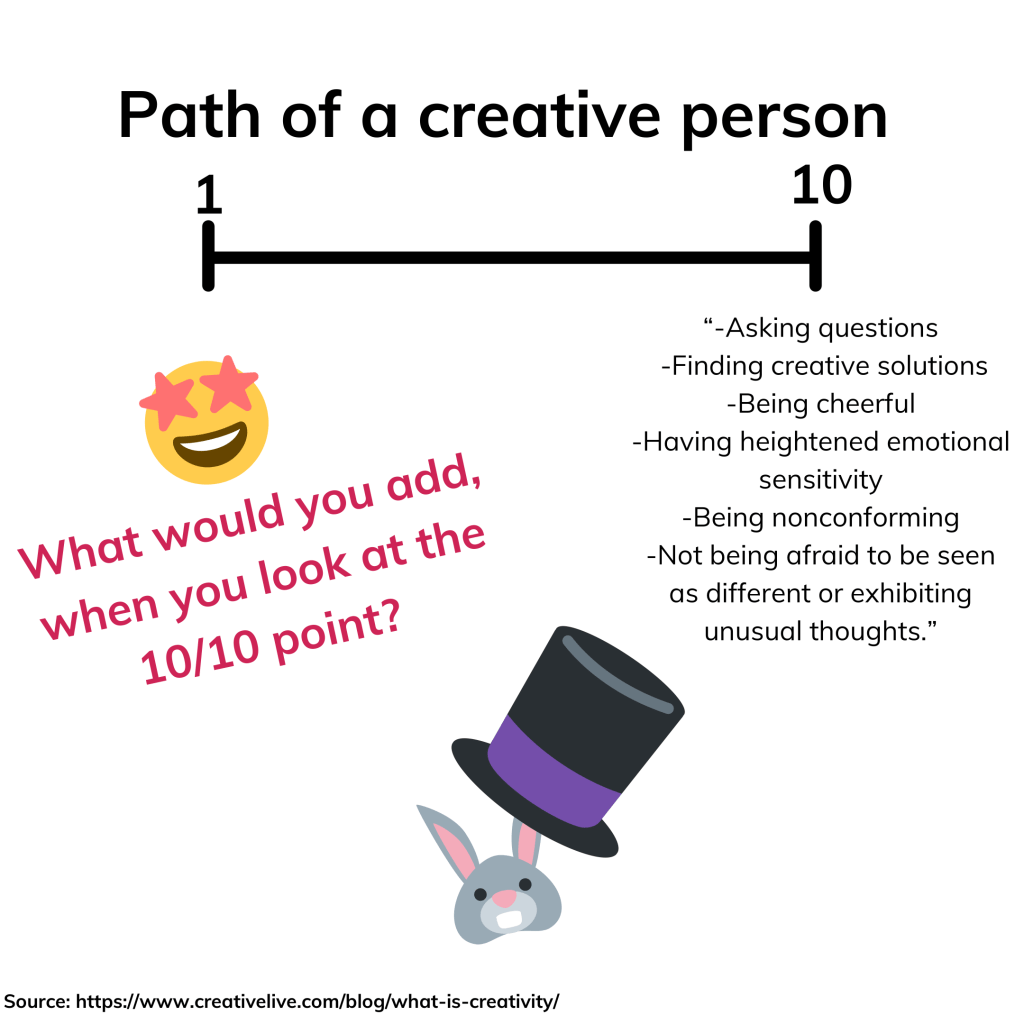
Everyone! But, there are certain characteristics of people who use their creativity fully. These characteristics are;
• “Asking questions
• Finding creative solutions
• Being cheerful
• Having heightened emotional sensitivity
• Being nonconforming
•Not being afraid to be seen as different or exhibiting unusual thoughts.” (6)
Wayne McIfGregor – the choreographer – is one of the people that I think is creative. McGregor shared his creative thinking methods through dancing in his TED talk. The part of his speech that inspired me the most was that his access to a local dance studio . He said “And that was the very first time that I found an opportunity to feel that I was able to express my own voice, and that’s what’s fueled me, then, to become a choreographer. I feel like I’ve got something to say and something to share.” (7)
One of the main points that draw attention in his speech is the technology of the body. Describing the body’s technology as “the most technologically literate thing that we have,” he says, “I’m absolutely obsessed with finding a way of communicating ideas through the body to audiences that might move them, touch them, help them think differently about things. ” (8)
Choreography for him is process of physical thinking process, a distributed cognitive process in which the body and mind work collectively. (9)
Physical thinking process and body
If there is a body, we can think physically. For example, we know when and how to hold a glass, with our inner perception. There may be times when we don’t realize it. It’s because we don’t think enough about our bodies, unless something goes wrong. This can be explained as giving more importance to our arm after injuring it by falling. (10)
But how do we begin to convey choreographic thinking and kinesthetic intelligence into ways we think about things more generally?
Every dance – thought or desire – has a starting point. Using this point, there are 3 ways;
1. To convey from body to body what we do with the external mental architecture studied and what the dancers hold in their memories for the choreographer.
2. We have a mental architecture and we share it, therefore, we solve a problem. To put it another way, using dancers to contemplate architectural objects – their shapes.
3. A task-based method where they can make their own decisions. Depicting a mental and vivid picture to enable the dancers to choose for themselves what to do. (11)
If I need to sum up the article in general;
Wayne McGregor’s speech was the starting point for this article and pushed me to do some more research on the subject. The part of the article I liked the most is being born creative and learned not to be as we grew up”. This is a definition that supports the definition I made at the beginning and you can see its reflection in other paragraphs of the article. (12) In addition to these, the concepts of being happy and in the flow (13) once again showed how valuable the subject is.

 Serra İspahani