The world is our home and we live in this house. It is such a house that we can live with the people we love and live the way we want. The person who makes this house a home is mother nature. She is the source of compassion that gives our food and blanket. What can we do for her? How can we respond to her love?
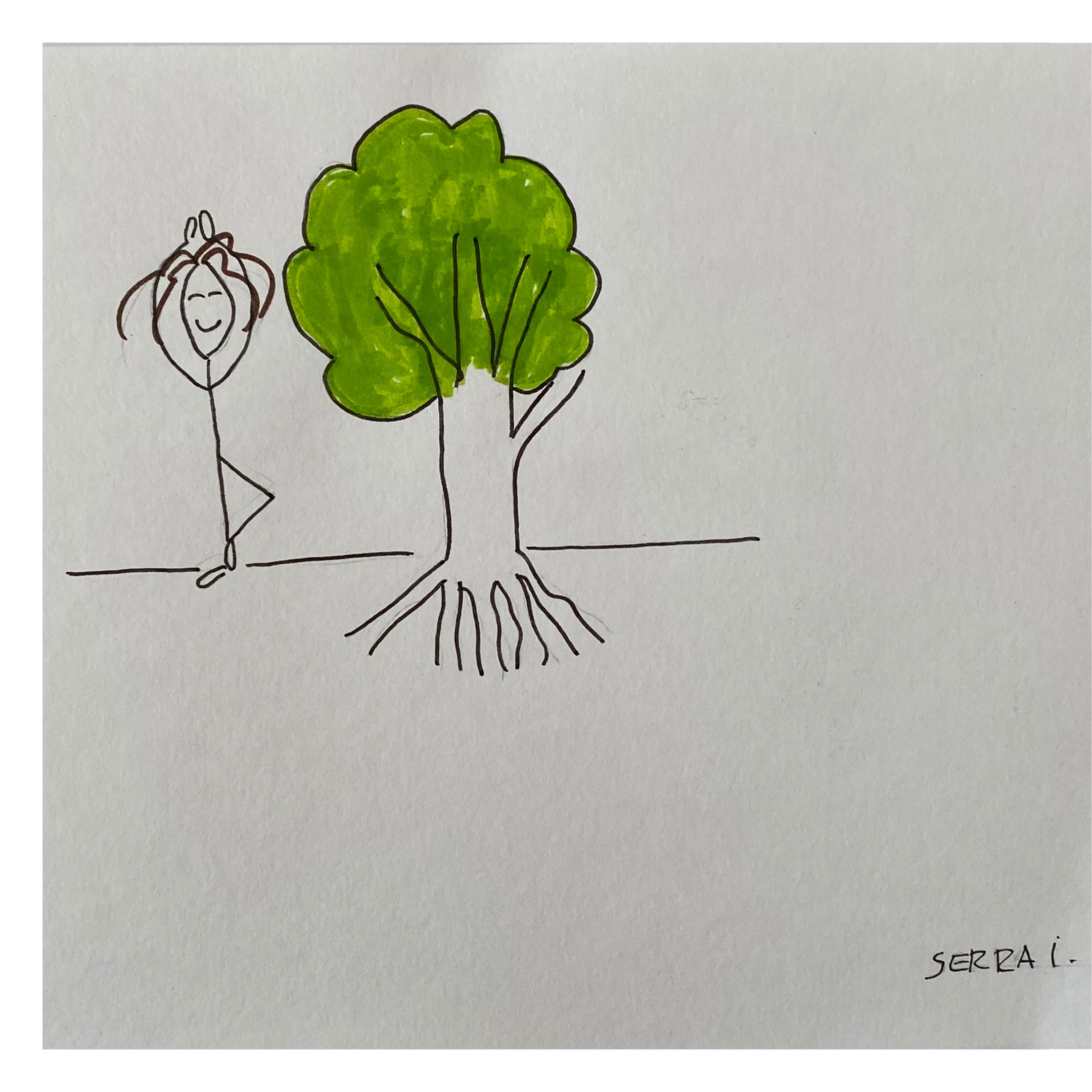
Alignment with nature. By observing her ways of thinking and acting accordingly. We can identify steps to protect and grow her.
Maintaining balance. To live by thinking that every living creature has the same right to live and by designing our steps according to them.
Nourishing it with love. To share our love for her by showing her our support.
Nature has caught my attention lately. I believe that flowers, animals and other parts of nature significantly improve our quality of life. Recently, I watched a documentary about nature called “Kiss the Ground” on Netflix. I felt almost every emotion while watching it. While it clearly explains what wars and similar bad things take away from the world in the long run, it also tells us what solutions we can use as human beings. At the end of the documentary, I saw that nature can heal itself when we apply right agriculture methods.
What did I learn from the documentary?
Saving the world is easier than we think. Another name for soil is dirt and this dirt is vital. Humans are not that different from other animals when we look at ourselves as homosapiens. Of course, we are not the same because our evolution is different, but; we are made up of biologically similar things and we take some of our steps by listening to our primitive brain. At this point, it can be said that we are more connected to nature than we think. We even work on issues such as social inequality today due to applying wrong agriculture methods that affect nature.
When a farmer shared his business going down and meeting biodiversity, he used a word that summarizes the documentary which is biodiversity. In this article, I will not describe techniques as my aim is to share points that I liked. However, the solution is to grow more plants in the soil rather than just one type of plant. The important thing absorbing the carbon from the air rather than sending it upwards and creating global warming. One of the main causes of global climate change is the drying of the soil.
The second thing I learned is that there are beneficial techniques for this in the world right now. Many devoted people are giving seminars and training people, while others continue their work to revitalize the soil. It was hopeful to hear their experiences in the documentary.
Putting all these into consideration;
The documentary really affected me with many factors that I wrote above and couldn’t because there were many. Presenting the solution in the most simple way made it easier for me to watch. I saw that there are many ways to contribute to this culture and they are not less complicated than we assume.
Note: Anyone who has watched the documentary and wants to watch it, please share your ideas with me via serraispahani@gmail.com or Instagram.
You can watch a video about the documentary by clicking here;
There is a type of conversation mentioned in one of Marilyn Atkinson’s interview about the concept of world game with Fabian Luetzig that inspired me very much which is called “Yes, and”. I read about it a few years ago and started using it more often these days. Without further ado, I would like to tell you about this conversation.
What is “Yes, and”?
With this conversation people can approach the questions asked or the situations they encounter in a more constructive way. To give an example; if I ask your favorite color, you would name 3 of them. However in this type of conversation, you might add other colors that you will remember after saying the first three. This creates a more open and strong communication space for them. (1)
Who else talked about this conversation?
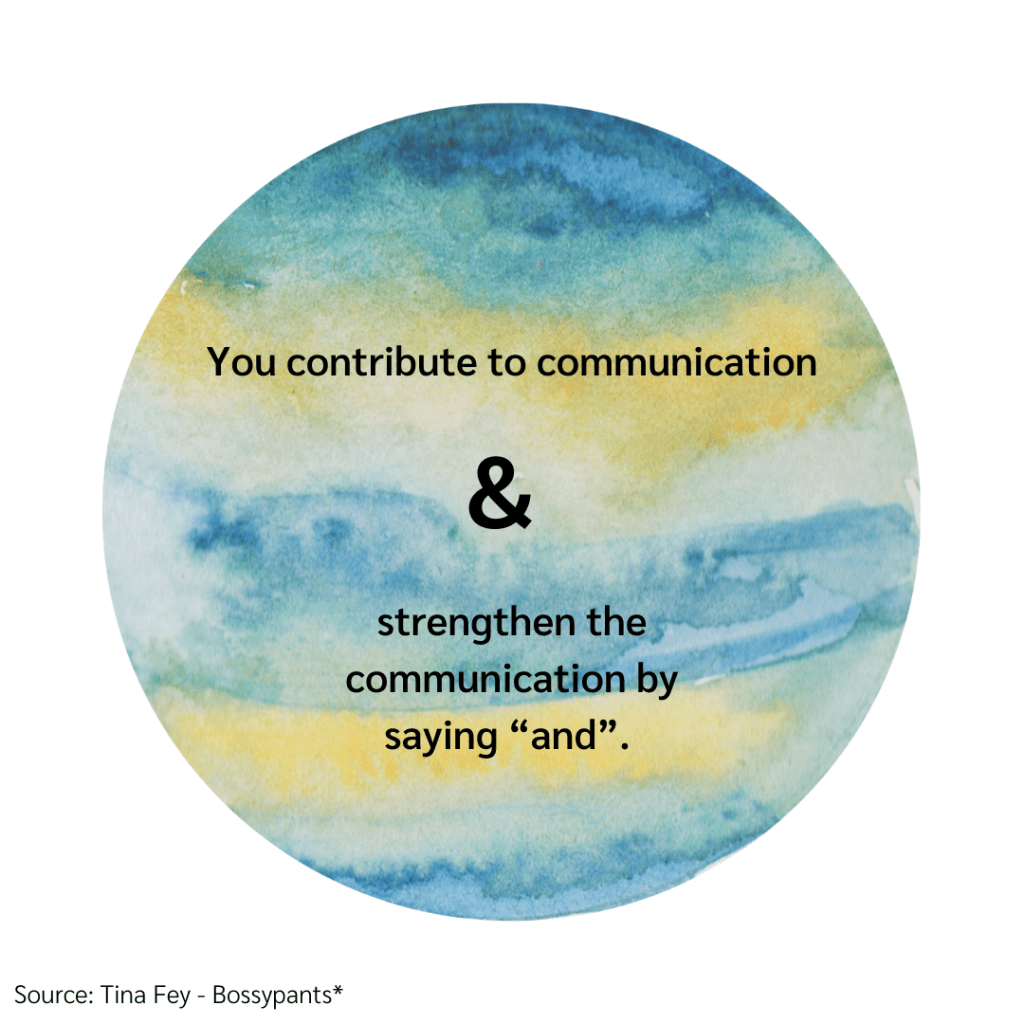
I was looking at other sources before I started writing this article. I found a resource that will enrich the topic. Tina Fey has a great book named “ Bossypants”. Part of the book featured an improvisation technique using this perspective. As I read the technique, I understood the conversation better. (2)
How does Tina Fey describe it?
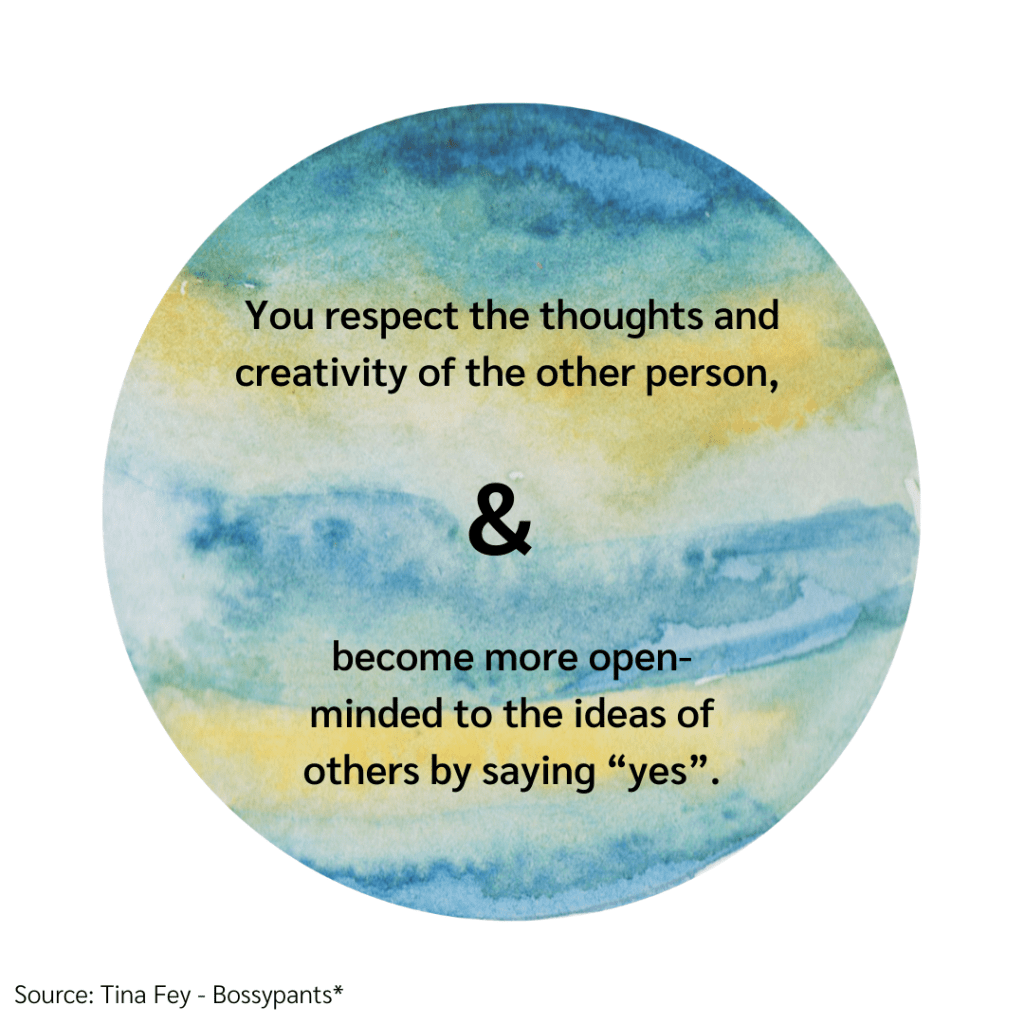
According to Fey, “The first rule of improvisation is AGREE. Always agree and SAY YES. When you’re improvising, this means you are required to agree with whatever your partner has created.” and she adds “the Rule of Agreement reminds you to “respect what your partner has created” and to at least start from an open-minded place. Start with a YES and see where that takes you.
Second rule is adding something of your own to what you agreed. As an example,if I say “Be careful it is windy outside.” You can say “ Yes it is windy! Do you see the flag over there? I can’t see it’s colors.”
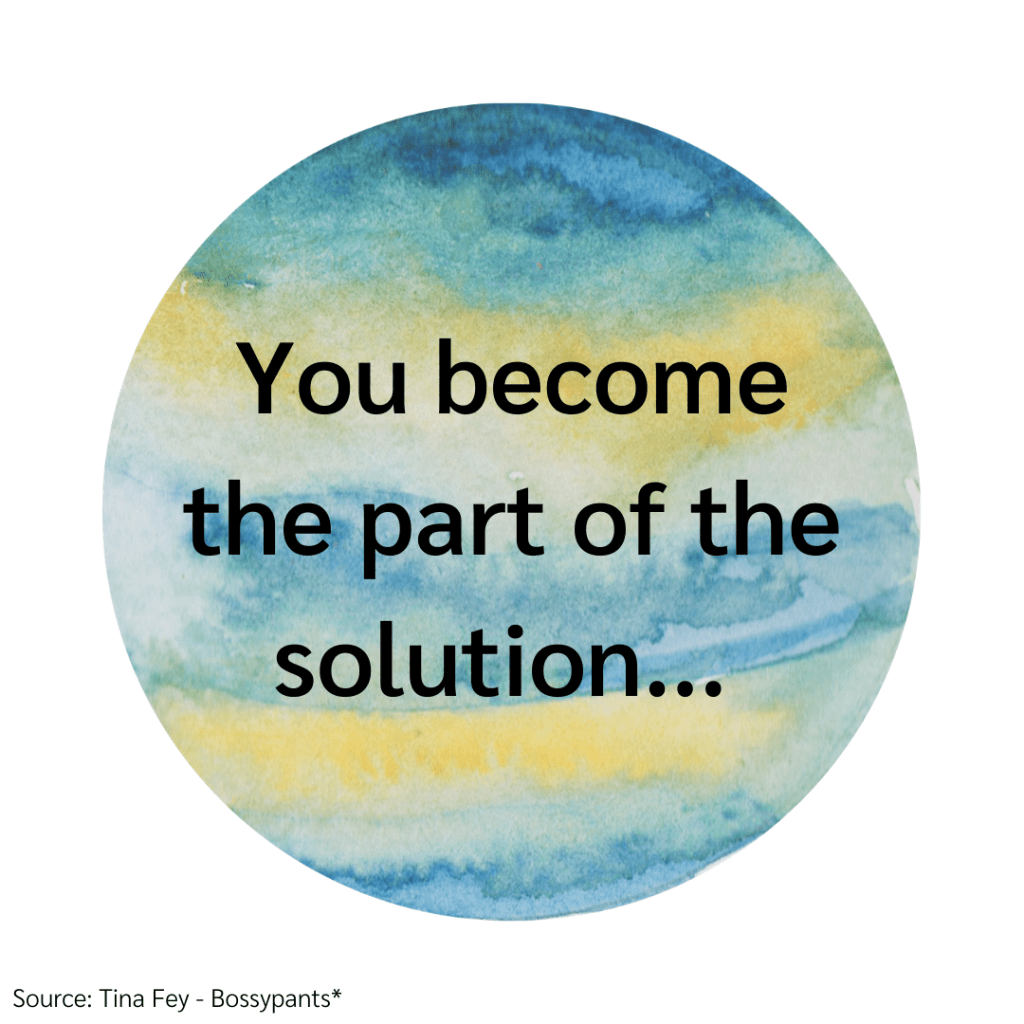
Third rule is making statements. This rule highlights the importance of being of the solution instead of the problem. To give an example; if you went to a restourant and waiters says that “ We don’t have the salad you asked.”, you have two options. You can either don’t eat anything and be hungry till you go home or ask another similar dish that will make you happy. (3)
While looking at additional resources , I came across another resource. This resource, unlike Fey’s improvisation technique, focused more on the business world. If I were to describe briefly, the listening to a thought without making assumptions makes value of the idea to be seen more. (4)
Putting all these into consideration, “Yes, and” reminds me of Don Miguel Ruiz’s “Be Impeccable With Your Word” agreement. To him, words are magical. (4) I also strongly agree with him. If we liken communication to a road, the words we use enable us to create the path exactly as we want. This perspective is not just magical, it shows your open perspective in communication.
Before I start the article, I want to ask you a question; What do you think is creativity? Which traits make a person creative?
While you are thinking about the answer, I am writing my answers here: In my opinion, creativity is being able to see and use our creative potential in more than one way.
To understand the subject from other angles, I did some more research and found another resource. Resource had a point of view that connected with other sources I had previously read and watched. Particularly, the creative process and the definition of being in the flow as the secret of happiness and the title of “Defining the Skill of the Future” were the parts that made me curious. (1)
Other than this definition, what made this article valuable?
Creativity make your ideas, imagination and dreams come true. When you are creative, you can see hidden patterns, make connections between things that are not normally relevant, and come up with new ideas. Creativity depends on creative thinking, which is part of the hard work but is connected more to creative problem solving. (2)
Mihaly Csikszentmihalyi says describes someone involved in the creative process as“ He can’t feel even that he’s hungry or tired, his body disappears, his identity disappears from his consciousness because he doesn’t have enough attention, like none of us do, to really do well something that requires a lot of concentration and at the same time to feel that he exists.”. (3)
Is creative thinking learned or is it in our nature?
Not being creative is something learned. People are born creative, but as they grow up they learn not to be. While we were told as children to reach for the stars, as we get older we begin to walk on a narrower path.
Therefore, if you see yourself as an uncreative adult, you can re-teach yourself to be creative and innovative and develop habits in this regard. (4)
What can you do other than going for a walk to improve your creativity?
• You can open yourself to new possibilities.
• You can maintain your curiosity about the world and your environment.
According to a study, 72% of our creative insights come in the shower. It may be new and fun information, but if you think we’re born creative anyway, you’re just removing the veil from something. (5)
Then I would like to ask you a question that you know the answer to but I think will be useful to reinforce the subject. Who is creative?
Everyone! But, there are certain characteristics of people who use their creativity fully. These characteristics are;
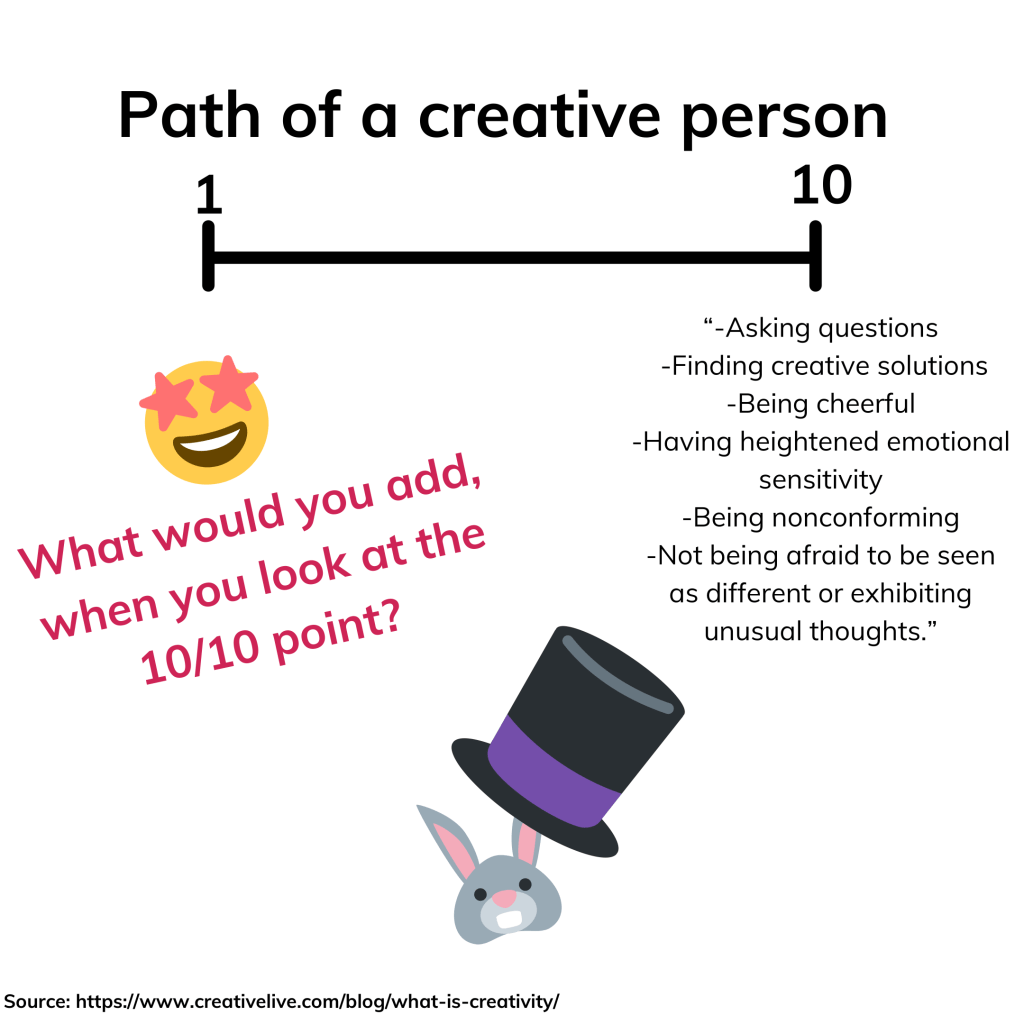
• “Asking questions
• Finding creative solutions
• Being cheerful
• Having heightened emotional sensitivity
• Being nonconforming
•Not being afraid to be seen as different or exhibiting unusual thoughts.” (6)
Wayne McIfGregor – the choreographer – is one of the people that I think is creative. McGregor shared his creative thinking methods through dancing in his TED talk. The part of his speech that inspired me the most was that his access to a local dance studio . He said “And that was the very first time that I found an opportunity to feel that I was able to express my own voice, and that’s what’s fueled me, then, to become a choreographer. I feel like I’ve got something to say and something to share.” (7)
One of the main points that draw attention in his speech is the technology of the body. Describing the body’s technology as “the most technologically literate thing that we have,” he says, “I’m absolutely obsessed with finding a way of communicating ideas through the body to audiences that might move them, touch them, help them think differently about things. ” (8)
Choreography for him is process of physical thinking process, a distributed cognitive process in which the body and mind work collectively. (9)
Physical thinking process and body
If there is a body, we can think physically. For example, we know when and how to hold a glass, with our inner perception. There may be times when we don’t realize it. It’s because we don’t think enough about our bodies, unless something goes wrong. This can be explained as giving more importance to our arm after injuring it by falling. (10)
But how do we begin to convey choreographic thinking and kinesthetic intelligence into ways we think about things more generally?
Every dance – thought or desire – has a starting point. Using this point, there are 3 ways;
1. To convey from body to body what we do with the external mental architecture studied and what the dancers hold in their memories for the choreographer.
2. We have a mental architecture and we share it, therefore, we solve a problem. To put it another way, using dancers to contemplate architectural objects – their shapes.
3. A task-based method where they can make their own decisions. Depicting a mental and vivid picture to enable the dancers to choose for themselves what to do. (11)
If I need to sum up the article in general;
Wayne McGregor’s speech was the starting point for this article and pushed me to do some more research on the subject. The part of the article I liked the most is being born creative and learned not to be as we grew up”. This is a definition that supports the definition I made at the beginning and you can see its reflection in other paragraphs of the article. (12) In addition to these, the concepts of being happy and in the flow (13) once again showed how valuable the subject is.
Suppose you have a wish that reflects you from today to the future and you want it to come true. How would you want it?
It’s actually a very easy question to answer. It comes to my mind to share what I want or think about what I can do to reach by writing. However, there is a very important step that you must take in order for your request to be heard and fulfilled; to ask in the most clear and simple way. If you want two or more things at the same time, your wishes may not come true. When you want something, you must use singular expressions. For example “I want to accomplish this and that today.” is a complicated expression for wanting something. In such a case, you need to sort your request according to your priorities.
Why is it important to prioritize?
Prioritizing something clears your path. You can reach what you want in easier ways.
How can you set priorities?
“Which of these do I want first?” and “Which of these will get me exactly where I want to be?” questions like these will help you set priorities.
How does coaching relate to learning to want something?
Perhaps one of the most important duties of coaches during coaching is to inspire the coachee by asking open-ended questions and not setting directions. During the coaching, focusing on the main goal is very crucial .Thus, coachee’s destination point becomes easier to reach. Marlyn Atkinson talks about intention and mindfulness in one of her articles. Where the two meet, your wishes come true as you wished from the very beginning. (1)
How can you combine intention and attention?
It is very important to want something truly . The more you want something, the faster it will come true. Sometimes, we may perceive the wishes of other people, even those who are not real like movie heroes, as our own. At this point asking “Do I really want this?” question can be very helpful. The scale to which we want something constitutes the attention we pay. To give an example; If you and your friends are interested in a common subject, your friend’s wishes may seem like yours too. You may be listening or even singing the same songs because a friend of yours likes the singer.
Understanding where intention comes from is therefore very important. (2)
Additionally, Dr. Joe Dispenza makes an invaluable statement about intention. With intention, people create a photograph in their brains. The important thing here is that you become determined to live what you see in that photograph. In other words, maintaining your intention increases the possibilities. At this point, you need to transfer the feeling of completeness to your state of experiencing what you want and prove its reality to your subconscious mind. (3)
To wrap up the issue;
Learning how to want is something that I have personally experienced and an outcome that I want everyone to experience as well. Erickson Coaching has shown me the difference between really wanting something and assumption of wanting, in both coaching and coachee positions. Intention and attention are the most important factors for wanting something. When you combine these two, everything happens easily as you want.
The world is changing and it has reflections on the dynamics of life. We live in a time that we can actually reach the stars and buy lands from Mars. The world is turning into an exciting place to live with the development of technology, economy, communication and science. The world we live in is full of innovation and development. There is not that much difference between small and big. (1) The only difference is how you use your rich resources.
If everything is so normal and almost equal, what can we do to take a strong step?
The 21st century is the best time for people to listen themselves. (2) Focusing on ourselves and understanding what we really want is the step that will take us the farthest. We can ask ourselves questions to align with ourselves. Awareness and integrity will bring us exactly to where we want reach.
What are the contributions of solution- focused coaching?
Solution-focused coaching is one of the areas that will provide tools for self-awareness and integrity. In fact, every behavior and belief is formed by the connection of neurons in our brain. New connections are formed everyday, creating new habits and choices. (3) Solution-focused coaching makes the position we want an accessible point with open-ended questions that will support us the most while these connections are being formed. I will share articles about the definition of coaching consisting of a few points with you. But speaking of coaching generally, Milton Erickson’s principles are one of the theories that describe coaching most clearly. Erickson explains how wonderful human beings are with 5 principles.
Principles;
People are OK:
Human beings everywhere are basically okay!
People have real resources:
They have many more resources than they know!
Every person has a positive intention:
Even if a positive intention is hidden, it can quickly be found.
People do their best:
They make their best choices each day with what they know about life so far.
Change is inevitable:
No matter how difficult, we learn, we grow, and we change. In this way, our acorn becomes an oak tree.
Marilyn Atkinson explains the principles in a way that will make you smile in one of her articles. If I write briefly; There are so many resources that you are unaware of, and there are ways to find those resources that you need less external resources than you think. (4)
What kinds of tools a solution-focused coach uses?
The only tool of a solution-oriented coach is powerful open-ended questions. By asking these questions to the coachee, coachee is being inspired to move forward. The only focus from start to finish is the coachee.
What is the general view of solution-focused coaching?
We live in an age where the world is changing rapidly and our self-awareness is one of the most important things. While developments in mechanization, technology and other fields offer us incredible resources; we should know ourselves better and use these resources in a way that will positively affect our personal development. While it may affect people negatively with the acceleration of mechanization, in order to overcome this, we should know ourselves well and make our choices. With solution-focused coaching perspective, we can see what we want from today to the future and move forward on our way.





 Serra İspahani